Choosing an optical transceiver is not just a matter of matching a connector to a port. The module must also support the required data rate, fiber type, transmission distance, and equipment platform. A mismatch can mean an unstable link or a part that cannot be used.
Common options include SFP, SFP+, SFP28, QSFP, and QSFP28 modules. They serve different bandwidth and network needs, from access switches to data center interconnects. Within each family, short-reach and long-reach models can differ substantially. The optical transceiver cost therefore depends on more than its form factor. Reach, wavelength, supported speed, diagnostic features, and manufacturer compatibility all affect the price.
Prices vary. A low-cost module may suit a short link between nearby switches, while a longer fiber run may require a more specialized optic. Third-party modules can reduce upfront spending, but buyers should verify compatibility and warranty terms before ordering. Brand-name options may offer clearer support, though they are not automatically the best fit for every network.
This guide compares major transceiver types and explains the cost factors behind them. It also highlights practical checks, such as confirming the switch model and measuring the actual link distance. Estimates can be imperfect: supplier pricing changes, and two modules with similar labels may not offer the same support or performance. A careful comparison is more useful than choosing by price alone.
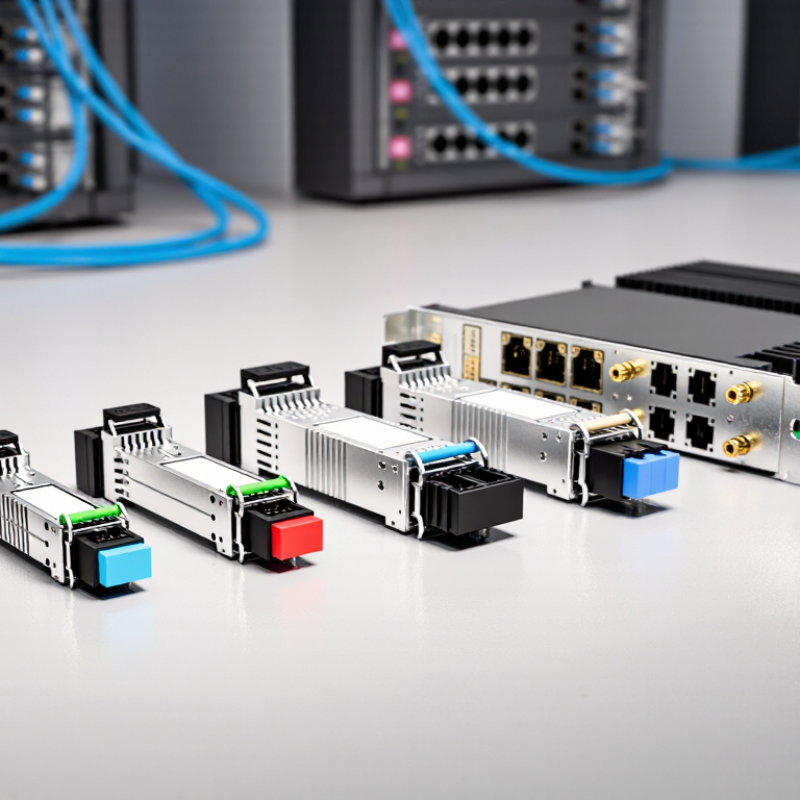
An optical transceiver turns electrical data into light for transmission through fiber, then converts incoming light back into electrical signals. Inside, a transmitter sends pulses at a defined wavelength, while a photodetector reads pulses at the other end. Light travels fast. The module’s circuitry also helps manage signal timing and monitoring. In real installations, clean connectors and suitable fiber matter as much as the module itself.
Cost depends on data rate, transmission distance, wavelength, and fiber type. A short-reach module for a data center usually needs less optical power than one designed for a long link. More demanding temperature ratings, diagnostic features, and tighter manufacturing tolerances can also raise the price. Compatibility and testing add practical costs. A stated reach is not a guarantee: fiber condition, connector loss, and network design affect actual performance. This part is easy to underestimate.
Tips: Match the transceiver to the equipment, fiber, distance, and required speed before comparing prices. Check the specification sheet and confirm the link budget. If two modules look similar, they may still differ in power use, heat, or interoperability. A small mismatch can mean extra troubleshooting.
An optical transceiver converts electrical data from network equipment into optical signals for transmission over fiber, then converts incoming optical signals back into electrical data. Typical modules use a laser or other light source to transmit and a photodiode to receive. The examples and estimated module prices below are general ranges in USD; actual prices vary by supplier, order volume, specification, and market conditions.
| Transceiver type | Typical data rate | Optical interface and wavelength | Typical reach | How it sends data | Indicative unit cost (USD) |
|---|---|---|---|---|---|
| 1G SX | 1 Gb/s | Duplex multimode fiber; approximately 850 nm | Up to 550 m, depending on fiber grade | A short-wavelength laser transmits over two fiber strands, one for each direction. | $10–$50 |
| 1G LX | 1 Gb/s | Duplex single-mode fiber; approximately 1310 nm | Up to 10 km | A 1310 nm laser carries the signal over single-mode fiber using separate transmit and receive strands. | $15–$80 |
| 10G SR | 10 Gb/s | Duplex multimode fiber; approximately 850 nm | Typically 300 m on OM3 or 400 m on OM4 fiber | A short-reach optical signal travels over multimode fiber on separate transmit and receive strands. | $15–$100 |
| 10G LR | 10 Gb/s | Duplex single-mode fiber; approximately 1310 nm | Up to 10 km | A single-mode laser transmits over a duplex fiber connection. | $25–$150 |
| 25G SR | 25 Gb/s | Duplex multimode fiber; approximately 850 nm | Commonly up to 70 m on OM3 or 100 m on OM4 | A high-speed short-reach optical lane carries data over multimode fiber. | $30–$180 |
| 40G SR4 | 40 Gb/s | Parallel multimode fiber; approximately 850 nm | Up to 100 m on OM3 or 150 m on OM4 | Four transmit and four receive optical lanes operate in parallel, typically using an MPO connector. | $60–$300 |
| 100G SR4 | 100 Gb/s | Parallel multimode fiber; approximately 850 nm | Up to 70 m on OM3 or 100 m on OM4 | Four parallel optical lanes transmit and receive data over a multimode fiber array. | $60–$300 |
| 100G DR | 100 Gb/s | Parallel single-mode fiber; approximately 1310 nm | Up to 500 m | Four optical lanes operate over single-mode fiber; a parallel-fiber connection is commonly used. | $150–$700 |
| 100G LR4 | 100 Gb/s | Duplex single-mode fiber; multiple wavelengths near 1310 nm | Up to 10 km | Four wavelengths are multiplexed onto one transmit strand and separated at the receiver. | $250–$1,500 |
| 400G DR4 | 400 Gb/s | Parallel single-mode fiber; approximately 1310 nm | Up to 500 m | Four high-speed optical lanes transmit and receive in parallel, commonly over an MPO connection. | $500–$3,000+ |
| 400G FR4 | 400 Gb/s | Duplex single-mode fiber; multiple wavelengths in the 1310 nm band | Up to 2 km | Multiple wavelengths are combined onto one strand and demultiplexed at the receiving end. | $800–$4,000+ |
| Cost factor | Why it affects price |
|---|---|
| Data rate and signal processing | Higher data rates require faster optical and electrical components, tighter signal tolerances, and more complex signal processing. |
| Transmission distance | Longer reach can require higher-performance lasers, more sensitive receivers, and tighter control of optical power and signal quality. |
| Fiber type and optical design | Multimode, single-mode, parallel-fiber, and wavelength-multiplexed designs use different optical components and connectors. |
| Number of lanes and wavelengths | Parallel lanes and wavelength multiplexing add optical components and alignment requirements, which can increase manufacturing complexity. |
| Power consumption and thermal requirements | Higher-speed modules may draw more power and need more careful thermal design, especially in densely populated equipment. |
| Form factor and packaging | Module size, connector type, mechanical tolerances, and compatibility with the host port affect design and production costs. |
| Testing, coding, and support requirements | Extensive testing, specified host-device compatibility, warranty coverage, and support can add to the purchase price. |
| Supply, demand, and order quantity | Newer or less widely produced formats may cost more; larger orders often reduce the per-module price. |
Price note: Cost ranges are approximate examples for individual modules, not fixed quotations. Prices can differ substantially with availability, volume, optical specification, warranty, and required compatibility. Always verify the module type, fiber, connector, wavelength, reach, and host-device requirements before purchase.
It converts electrical data into light for fiber transmission. At the receiving end, a photodetector turns incoming light back into electrical signals.
Data rate, transmission distance, wavelength, and fiber type all affect price. Temperature ratings, diagnostics, testing, and compatibility can add costs too.
They often cost about $10 to $60 each. They commonly connect nearby racks using multimode fiber. Check the actual distance before choosing.
Long-reach modules for links up to roughly 10 kilometers often cost $20 to $150. Extended-reach models may range from $100 to over $1,000.
Match its data rate, module type, fiber, connector, wavelength, and reach to both ends of the link. Small mismatch, big problem.
It accounts for transmitter output, receiver sensitivity, and losses from fiber, connectors, and patch panels. Leave some margin beyond the expected losses.
It may work, but a very short link can require attenuation. Check the module specifications and link conditions first.
Not necessarily. Include compatible cabling, spares, and possible replacement costs. I’d also record tested part types and link readings; troubleshooting can expose what was missed.
Optical transceivers convert electrical signals into light and back, enabling data to travel across fiber-optic networks. Their design, wavelength, data rate, and transmission distance all influence optical transceiver cost. Common form factors support different equipment and port requirements, while speed options range from lower-capacity links to high-bandwidth connections. Short-reach modules are generally more affordable because they serve nearby devices; long-reach and extended-reach models typically cost more due to their greater optical power, sensitivity, and component requirements.
Purchase price is only part of the overall expense. Compatibility, fiber type, power consumption, cooling needs, reliability, and expected replacement frequency can affect both upfront and operating costs. To choose a suitable transceiver, first identify the required speed, reach, fiber infrastructure, and equipment compatibility. Then compare the total cost of ownership with the network’s performance and future expansion needs. Selecting a module that meets actual requirements can help avoid paying for unnecessary reach or capacity.

 FiberNova